Investors Go Berserk For Viking, Putting It Top Of Q1 Winners
The top 10 biggest share price winners and losers in Q1 from Evaluate show the investor frenzy for obesity drugs continues, while companies with governance doubts see shareholders retreat.
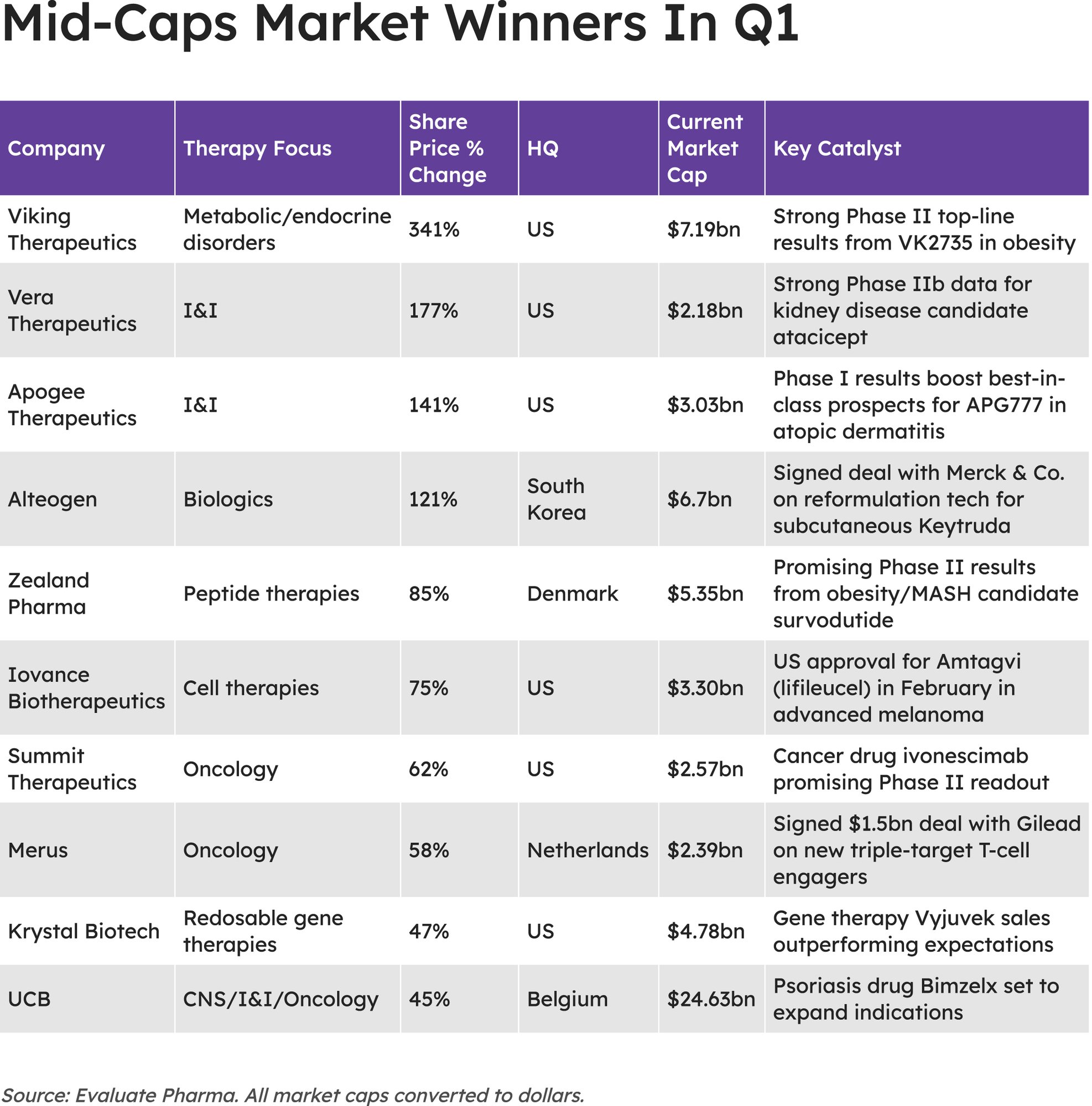
Viking Therapeutics’ share price soared in Q1 as generalist investors continued their landgrab of biopharma companies developing novel obesity therapies. That put it top of the share price gainers among mid-cap companies in Q1, according to data from Evaluate.
The US company has seen its stock triple in value since January, driven by promising mid-stage data from its dual GLP-1/GIP receptor agonist, VK2735, in obesity patients (see Table 1).
Analysts believe the 14.7% weight loss at 13 weeks reported in a Phase II trial in February means it could eventually take a share of a market currently divided between Eli Lilly’s Zepbound (tirzepatide) and Novo Nordisk’s Wegovy (semaglutide).
That has put pressure on its leadership to make the right calls on how to maximize its opportunities. CEO Brian Lian recently told Scrip the company is minded to find a partner to help market the drug though it is no secret that Viking is also high on big pharma M&A target lists; Pfizer is the most frequently named company in ongoing buyout speculation.
NEW KIDS ON THE I&I BLOCK
Another segment generating mid-cap share price spikes is inflammation and immunology (I&I). In January, Vera Therapeutics unveiled strong Phase IIb data for its kidney disease candidate, atacicept, a dual inhibitor of BLyS and APRIL cytokines.
Analysts tipped it to lead a future autoimmune disease market, including conditions such as IgA nephropathy and lupus nephritis. Vertex has just acquired of another player in the field, Alpine Immune Sciences Inc., ratcheting up the competition, though investors believe there is room for multiple therapies.
Meanwhile, Apogee Therapeutics impressed investors with Phase I results from its IL-13-targeting antibody, APG-777, in atopic dermatitis. The product’s extended half-life profile suggests it could be best in class in the field, and take on more advanced assets such as Eli Lilly’s anti-IL-13 competitor, lebrikizumab.
A more established mid-cap, UCB, is also thriving in the field. It has pulled off a successful US launch of IL-17A and IL-17F inhibitor psoriasis drug, Bimzelx (bimekizumab), and the therapy’s peak annual sales are now forecast to reach as high as €5bn-€6bn.
In January, UCB also filed rozanolixizumab, a subcutaneous antibody targeting the neonatal Fc receptor (FcRn) for adults with generalized myasthenia gravis (gMG). These positive developments have seen its stock surge up by 44% in Q1, and has its continued to rise to €120 per share now.
HEADING DOWN
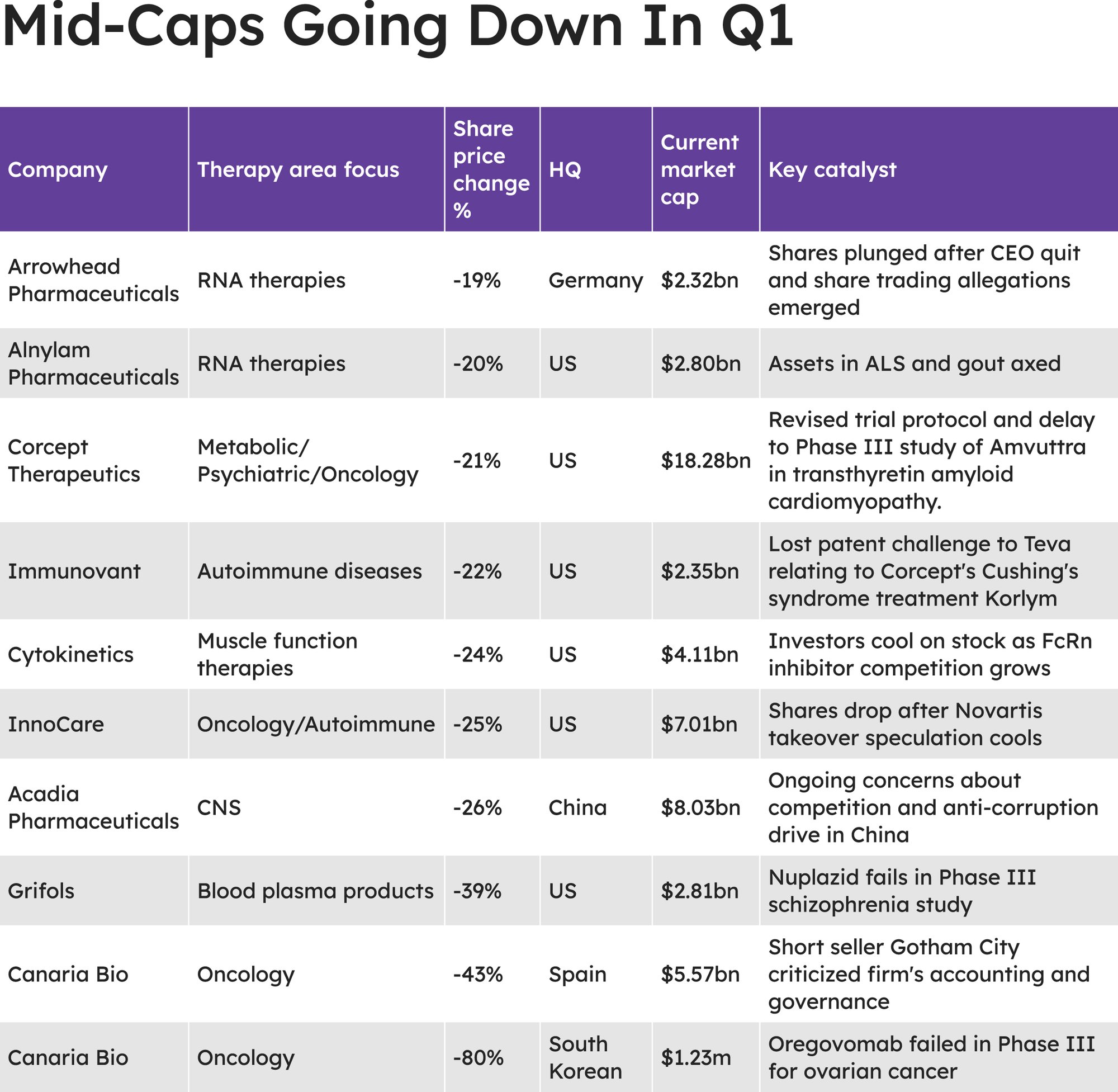
Meanwhile, the list of the10 biggest share price decliners shows a multitude of reasons for shareholders turning against these mid-cap firms.
On the flipside to UCB in the FcRn field was Immunovant, which lost a quarter of its value in the period. Its rival’s progress was a factor weighing on its share price, though that could reverse in the second half of the year when a Phase III readout from its candidate, IMVT-1402, is expected.
Also suffering from an investor exodus was Evotec, its shares plummeted after its highly rated CEO Werner Lanthaler unexpectedly departed in January.
The crisis deepened when it emerged that Lanthaler had allegedly broken rules around company share trading, and with no permanent new CEO in place, its stock remains down by more than 33% at just over €13.
A more predictable reason was behind the decline of Acadia Pharmaceuticals, the failure of its antipsychotic Nuplazid (pimavanserin) in a Phase III schizophrenia study. It is looking to turn things around with a new head of R&D, the ex-Amgen scientist Liz Thompson, but is yet to see a recovery in sentiment.
However, the hardest hit in the mid-sized field was blood product specialists Grifols which saw $3.8bn wiped from its market value in January when short-seller fund Gotham City Research questioned its accounting standards and debt burden. The company dismissed the report and launched legal action, but declined a further 10% in February when it reported a steep drop in its 2023 profits.