Venture Capital Fundraising Rebounds In Q1 As Mega-Rounds Dominate
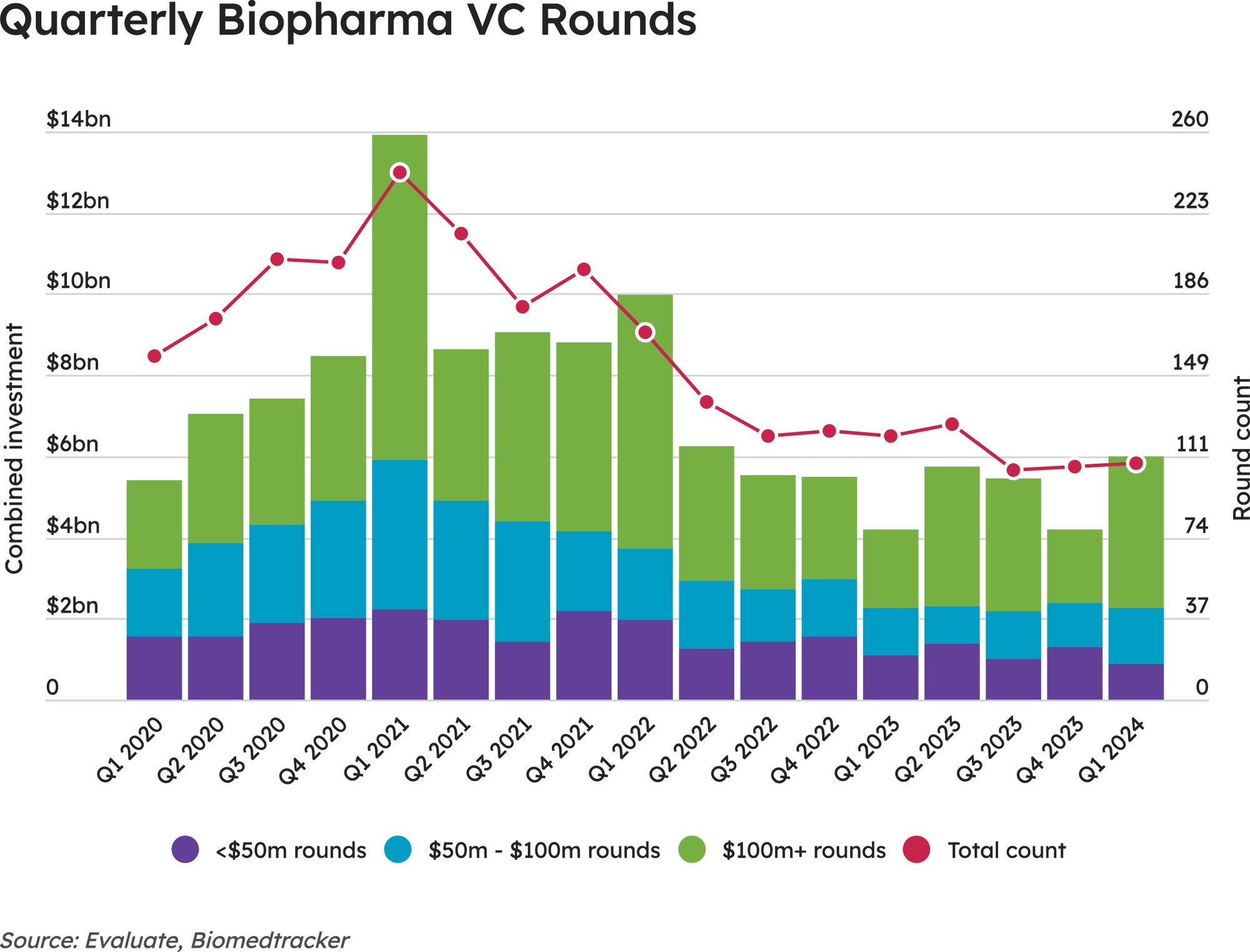
Biopharma firms raised $6bn in the first quarter of 2024, the most of any quarter since Q2 2022. But without an increase in the number of companies raising funds, the rebound remains uneven.
Biopharmaceutical companies have raised one venture capital mega-round after another in 2024 – with several of the $100m-plus financings often announced on the same day – and first quarter VC fundraising data from Evaluate show that big bets placed by investors on drug developers during the quarter added up to a rebound in venture financing.
A review of Evaluate’s database showed that biopharma companies raised $6bn in venture capital during Q1, including $3.74bn worth of $100m-plus financings, $1.39bn in $50m-$100m rounds and $0.87bn in rounds totalling $50m or less. The Q1 sum is the largest quarterly total since Q2 2022, when drug developers raised $6.24bn. The quarterly totals in 2023 ranged from $4.2bn to $5.74bn.
KEY TAKEAWAYS
Venture capital fundraising rose from $4.21bn in the first quarter of 2023 to $6bn in Q1 of 2024, but the number of financings fell as fewer companies raised larger rounds.
With M&A and IPO activity on the rise, VC funding could increase further in 2024.
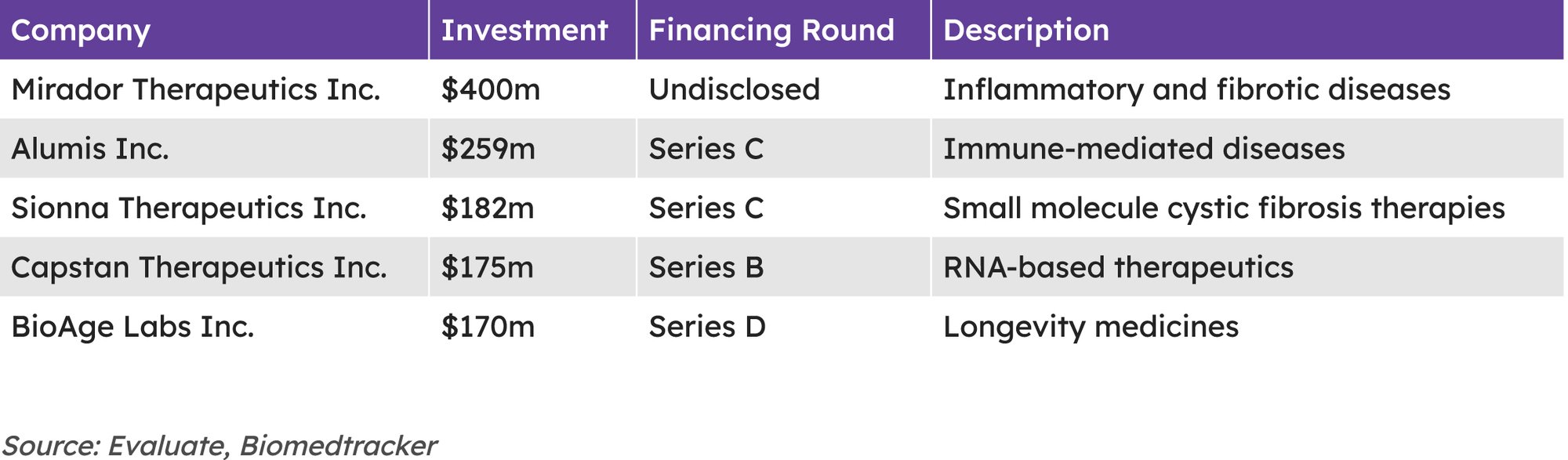
Mirador topped the list of Q1 fundraisers with a $400m launch in March
The initial recovery from venture capital funding declines in 2022 and 2023 is a bit uneven, however. While the amount of money raised in Q1 2024 is up from $4.21bn in Q1 2023, the number of companies that raised VC funding fell to 108 from 121 in the year-ago quarter. The average deal size rose to $55.6m versus $34.8m, which is good news for the companies that raised money, while the decline in the number of firms funded is bad for those struggling to finance their operations.
The year still has time for further recovery as other components of the financial markets improve. Merger-and-acquisition activity has grown more robust in recent quarters – spiking in Q4 of last year and Q1 of this year, according to Evaluate – in terms of both the number and the dollar value of deals. M&A activity feeds investor interest and the market for initial public offerings appears to be improving as well, giving VC investors another reason to back start-ups.
The number of first-time biopharma offerings in the US fell from record highs in 2020 and 2021 to 22 IPOs in 2022 and 21 in 2023. But with nine offerings in Q1 of 2024, this year could be on track to improve from the past two years if the quarterly number holds throughout 2024. Boundless Bio Inc. grossed $100m in the final IPO of Q1 on 27 March and Contineum Therapeutics Inc. launched the first IPO of Q2, grossing $110m on 4 April.
Growth-stage private companies, in particular, benefit from a healthier IPO market as crossover investors step up to support large pre-IPO venture capital financings for start-ups nearing the public company precipice. The relative health of the IPO market – thanks to the rise in M&A – may be behind the Q1 surge in VC financings in which 25 companies raised $100m-plus mega-rounds as crossover investors seemed to re-enter the VC market.
Notably, the top VC fundraiser in Q1 does not have any drug candidates in the clinic, but it is led by executives from Prometheus Biosciences, Inc, which Merck & Co., Inc. acquired for $10.8bn last year to access the company’s Phase III-ready TL1A inhibitor for inflammatory bowel disease. Mirador Therapeutics raised $400m in March with plans to file multiple investigational new drug (IND) applications in 2025 for candidates from its precision immunology and inflammation pipeline.
Alumis, Inc. followed Mirador with $259 in series C funding – also announced in March – to support mid- and late-stage trials for its TYK2 inhibitor in the treatment of autoimmune diseases Sionna Therapeutics, Inc., another March fundraiser, brought in $182m in series C funding to support early- and mid-stage clinical trials of its cystic fibrosis drug candidates.
Rounding out the top five fundraisers in Q1, Capstan Therapeutics Inc. raised a $175m series B round in March to fund its in vivo RNA technologies, starting with targeted lipid nanoparticles (tLNPs), including development of its lead tLNP program through clinical proof of concept. BioAge Labs, Inc. closed a $170m series D round in February to fund development of its muscle-sparing drug azelaprag, including Phase II trials in combination with Eli Lilly and Company’s Zepbound (tirzepatide) and other obesity drugs.