The Steps to Commercial Success
1. PLAN AHEAD
Many biotechs start preparing for commercial launch too late, believing that a good drug will sell itself. "We’ve created a wonderful drug, so doctors will prescribe it and patients will want it," is what some firms tell themselves, says Outten, who helped launch Pharmacyclics’ cancer drug Imbruvica (ibrutinib) in 2013 – setting the stage for AbbVie’s $21 billion acquisition two years later. Even first-in-class, highly differentiated products require significant groundwork, almost all carried out pre-approval. The key decision areas are around:
Hiring and training
Access to therapy
Engaging with the prescriber and patient community
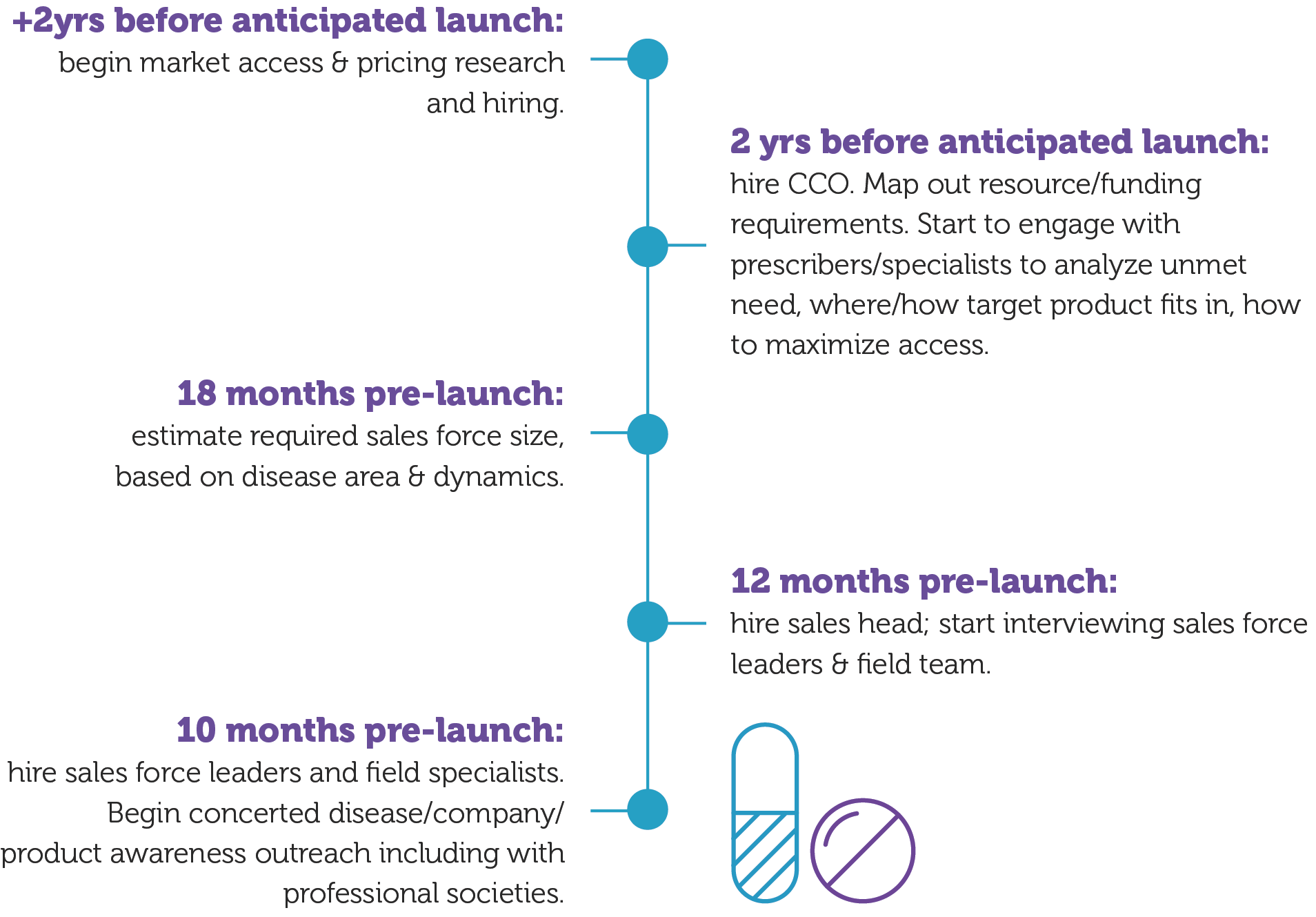
Hiring teams six-to-nine months pre-launch won’t cut it – especially for a first drug. It takes time to find suitable people (even with more available expertise). Two years before anticipated approval is the sweet spot for building the teams and infrastructure required; market access and pricing research can start even sooner, according to executives at the current generation of biotech-marketers. (See Exhibit: Ideal Pre-Launch Timing). "With ever-changing market dynamics, smart companies should determine what a responsible price would be, and debate it continuously, right up to approval," says BridgeBio’s Outten.
Some biotechs, like BridgeBio and Ionis, mapped paths to their first major drug launch many years in advance. (See Box: License, Partner, Launch).
Engagement with prescribers is another activity that should begin early, to determine wants and needs, and where a new product could fit in. Building awareness among professional disease associations is also a good idea, including through scientific papers (written and reviewed months in advance). Madrigal’s article on Rezdiffra’s Phase 3 data appeared in the New England Journal of Medicine weeks before Rezdiffra’s approval in March 2024; two liver societies, including the European Association for the Study of the Liver (EASL) updated their treatment guidelines, post-approval, to recommend the drug as first-line therapy.
Firms should engage in regular communications with regulators, and scenario test different potential drug labels. What claims and marketing materials would be possible in each scenario? Which label claims are worth fighting for? Verona’s Martin gives the example of exacerbation rates in COPD, which the company had determined was a "nice to have", not a make or break; exacerbations did not feature in Ohtuvayre’s label, which positions the drug broadly as maintenance therapy.
Hiring teams six-to-nine months pre-launch won’t cut it – especially for a first drug.
Exhibit: Ideal Pre-Launch Timing
LICENSE, PARTNER, LAUNCH
Ionis was for years a pure R&D machine, licensing its RNA-based drug to others – drugs like Qalsody (tofersen) or Spinraza (nusinersen), marketed by Biogen for amyotrophic lateral sclerosis (ALS) and spinal muscular atrophy, respectively. Five years ago, when current CEO Brett Monia took the reins, he set out a stepwise plan toward selectively commercializing some assets single-handedly. In 2021, Ionis began co-commercializing transthyretin amyloid polyneuropathy (ATTR-PN) drug Wainua (eplontersen) alongside partner AstraZeneca, gaining experience and building infrastructure. Tryngolza, approved in December 2024, is the first of four independent drug launches planned over the next two years. Having made the decision to go commercial, "we knew had to move in a measured manner," said Monia during the JP Morgan Healthcare conference in January 2025. Given a busy pipeline, focus was key and some assets had to be partnered.
Attruby is BridgeBio’s third launch and, similarly, marks the culmination of nine years’ hard work, said CEO and founder Neil Kumar at the JP Morgan event. The company initially co-commercialised bile duct cancer drug Truseltiq (infigratinib) with Helsinn. But in 2022, finding itself too stretched, it relinquished full rights to its partner. A smaller, highly specialist drug, Nulibry, was ultimately sold to Sentynl in 2022. "Both launches helped us learn that you can’t just do what everyone else is doing," says Outten.
2. DARE TO BE DIFFERENT
An expanding pool of biopharma experts is all well and good but demands careful selection. "You have to be mindful that, if you hire people straight out of Big Pharma, they are likely to come in and do things the exact same way larger firms do," cautions Outten. They avoid risk.
Yet biotechs seeking to win – especially those facing direct Big Pharma competition – need to "be brave and ready to do things differently." Thinking outside the box may include more aggressive steps to maximize patient access, such as free life-time product supply for trial patients. It may mean daring to match or even undercut a direct competitor on price, even with a supposedly better drug.
Creative promotional tactics might also feature: BioHaven famously recruited influencer Khloé Kardashian to push Nurtec ODT on TV. Yet small firms can also exploit more targeted channels, such as closed-circuit TVs in specialist treatment centers, or caregiver chat communities. "It’s not always about targeting patients directly," says Verona’s Martin. Spouses or other family members are often closely involved in treatment decisions.
Thinking outside the box may include more aggressive steps to maximize patient access.
3. BE FAST AND FLEXIBLE
Speed is everything in a drug launch – especially given increasing competition in most areas. Madrigal, for instance, will soon face Novo Nordisk’s behemoth semaglutide (marketed for diabetes/ obesity as Ozempic/Wegovy), expected to file for MASH approval this year. Establishing Rezdiffra as a foundational therapy in the space and underscoring its differentiating factors – such as oral once-daily delivery, a liver-targeted mechanism of action, and high tolerability – is therefore critical. So, adds Huntsman, is patient education around MASH and the damage it can cause, even before symptoms appear. Madrigal began a targeted direct-to-consumer campaign in August 2024, expanded to regular TV in January. The company is also working to ensure physicians’ offices know which non-invasive tests are available to identify eligible patients.
Experienced people get such things done faster, which is why it makes sense to hire executives who have been through the process and/or worked together (Madrigal CEO Bill Sibold and CCO Carole Huntsman worked together for 11 years at Sanofi, for instance). This can also compensate, to an extent, when timelines are off: Huntsman arrived in November 2023, just months before Rezdiffra’s approval and launch. "I would have preferred to have the team in place at least a year before," she acknowledges. "But it is not the first time I’ve done things in a hurry."
Flexibility is another requirement. Things will not always go to plan – whether it’s the hiring process, an unexpected pandemic, a delayed approval, a less-than-ideal label, slow reimbursement coverage, or manufacturing setbacks. (See Box: Making it happen). Teams must be able to adjust to these changes.
Most biotech firms also face financing risk. They may find themselves lacking sufficient resources to scale up along ideal timelines. "Firms must scale at the time that is appropriate to their financing situation," notes Verona’s Martin. It isn’t always a question of having to wait (or about-turn entirely); some firms scale too early and may be stung by an approval delay.
Field force size and overall launch budgets will vary widely depending on the product in question: is it an ultra-rare disease drug or a pioneer product in a growing field like MASH or COPD? "Overall resource requirement is sized to each product. Launch budgets for all the products I have worked on have been very different," says Huntsman, who has worked on multiple drug launches.
Experienced people get such things done faster, which is why it makes sense to hire executives who have been through the process and/or worked together.