Best Practice Considerations for Creating a Pharmaceutical Forecast
Whether you're preparing to launch a new therapy, managing a portfolio, or planning how to allocate resources, having a reliable forecast can give you a real edge. It's not just about planning ahead - it’s about gaining a clear view of how the market might evolve and making informed, strategic decisions.
Strong forecasting follows a structured approach. The most effective forecasts blend multiple methodologies; each suited to different stages of the product lifecycle and specific business objectives. In this guide, we’ll walk through key steps and best practice tips to help you build a forecast that’s both credible and decision ready.
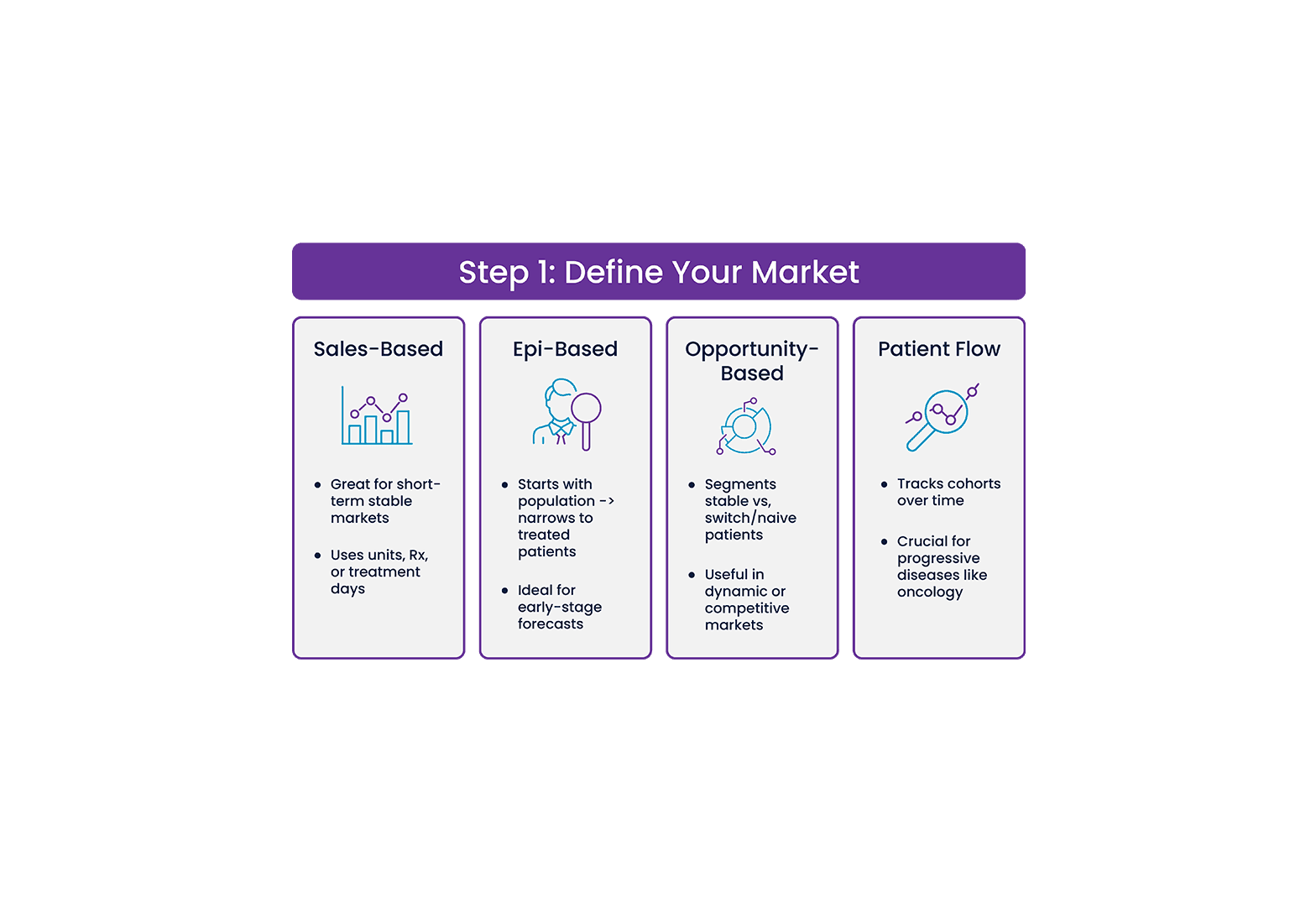
Market definition is the cornerstone of any pharmaceutical forecast. Depending on the type of product and market maturity, there are four primary methodologies:
Sales-Based Forecasting
This approach is ideal for short-term, tactical planning in stable markets. It leverages historical sales data - volume (units, prescriptions, treatment days) or revenue - to project future performance. While revenue can be used, it's generally less preferred due to potential distortions from pricing changes.
Epidemiology (Epi) Patient-Based Forecasting
An epi-based model starts with a broad population (e.g., total country population or specific age/gender subgroups) and applies disease prevalence, diagnosis, and treatment rates to estimate the addressable patient population. This method is particularly effective for early-stage pipeline products or new therapeutic areas.
Opportunity-Based Forecasting
This model segments the treated patient population into stable and opportunity categories. Opportunities may include treatment-naïve patients or those switching from one therapy to another, including add-on therapies. It provides a realistic view of potential market penetration, especially in competitive or evolving markets.
Patient Flow Forecasting
This approach tracks patient cohorts over time, capturing transitions across treatment lines and disease progression. It's especially valuable in complex, progressive diseases like oncology, where duration on therapy and transition probabilities (e.g., time between treatments, retreatment eligibility) significantly influence demand.
After defining the market, the next step is to understand how it evolves over time. Two main methods are used to trend historical data:
Judgmental-Based Trending
This method involves user-defined assumptions about future trends - such as uptake curves and expected market share - based on expert knowledge, recent market events, or analogs.
Algorithm-Based Trending
Here, trends are generated using statistical algorithms that analyze historical data patterns. This method is useful when robust historical data is available, and objectivity is a priority.
When evaluating historical trends, consider the following factors:
Recent events that may have disrupted normal patterns
Aberrant observations or outliers that skew trends
Structural breaks that render older trends irrelevant
Seasonality, which can distort comparisons without proper adjustment
Training course: To take your understanding of time series forecasting even further, we’re excited to introduce our new Forecasting: Time Series Essentials online course. Aimed at those at the start of an intermediate level of understanding, this course offers a deep dive into the theory and practical application of trending techniques across pharmaceutical forecasting scenarios. It’s the perfect next step if you’re looking to strengthen your knowledge base and confidence.
Download Brochure and Get Started
Forecasting also requires consideration of upcoming events that could disrupt or shape market dynamics. These events typically fall into three categories:
Market Events: Broader changes, such as new treatment guidelines or reimbursement policies.
Class Events: Competitive dynamics within a therapeutic class, like new MOAs or generics.
Product Events: Specific to a product, such as a launch, label expansion, or supply disruption.
Events can impact market share through:
Stealing: Gaining share from competitors.
Expanding: Growing the overall market (e.g., treating more patients).
Forecasts inherently involve uncertainty. The best practice is to embrace this by modeling uncertainty through structured techniques.
Scenario-Based Forecasting
This method involves building multiple forecast versions - typically base, best, and worst cases - based on varying assumptions. It’s essential to identify which variables are most uncertain and have the largest impact on outcomes.
Probability-Based Forecasting (Monte Carlo Simulation)
Essential to identify which variables are most uncertain and have the largest impact on outcomes.
Rather than assigning a single fixed value to an uncertain assumption, this method assigns probability distributions. Monte Carlo simulations then run thousands of iterations to produce a range of outcomes, each with an associated likelihood—offering a more nuanced view of potential performance.
A suite of advanced forecasting software that redefines industry standards.
Whatever your forecasting needs, FC+ offers an Excel-based solution that is quick, consistent and simple thanks to a range of add-ins across Epidemiology, Sales and Oncology.
Take a look
For markets with rich historical data, econometric modeling can uncover relationships between performance metrics (e.g., unit sales) and key drivers like pricing or promotional spend. These models quantify impact (e.g., a 10% price increase leads to a 5% drop in volume) and support strategic decisions with evidence-based insights.
Creating an effective pharmaceutical forecast is both an art and a science. The most effective forecasts are clear, flexible, and grounded in a strong understanding of the market, the data you’re working with, and your overall business goals. When done well, forecasting becomes more than just a numbers exercise—it becomes a tool to help you anticipate change, spot opportunities, and support better decisions that ultimately benefit patients.
Find out how we help
www.evaluate.com | info@evaluate.com | T +44 (0)20 7377 0800