Mid-Cap Biopharma’s Biggest Winners And Losers Of 2024
Summit Therapeutics hit the stock market heights in 2024, along with a handful of biotech with novel therapies and platforms, while Moderna was dragged down by shrinking COVID-19 vaccine sales.
Last year was far from vintage for the biotech sector in terms of stock performance: the S&P Biotechnology Select Industry Index rose by only 3% in 2024, and lagged far behind the 25% achieved by the S&P 500 and big tech firms, which hit record highs.
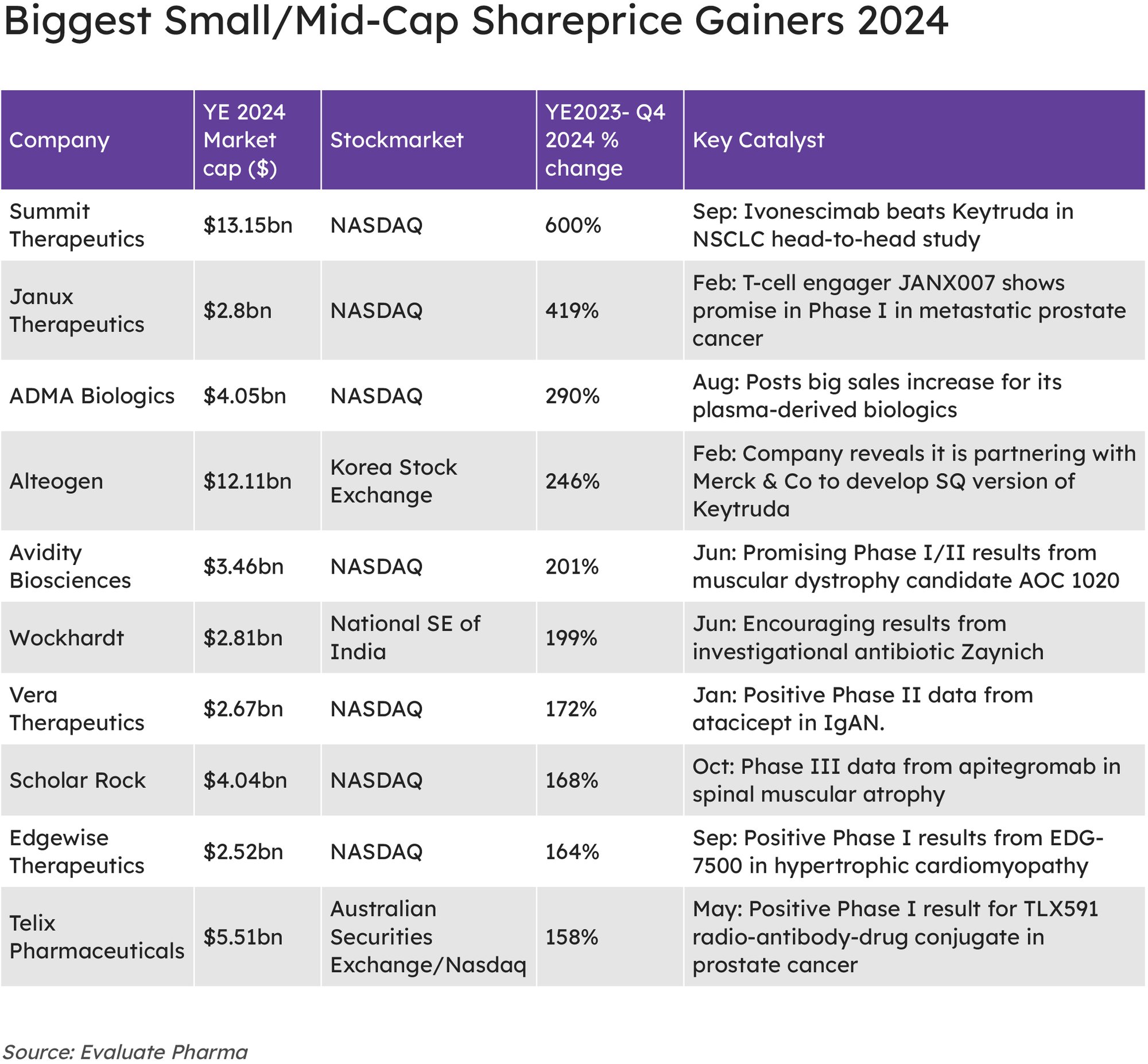
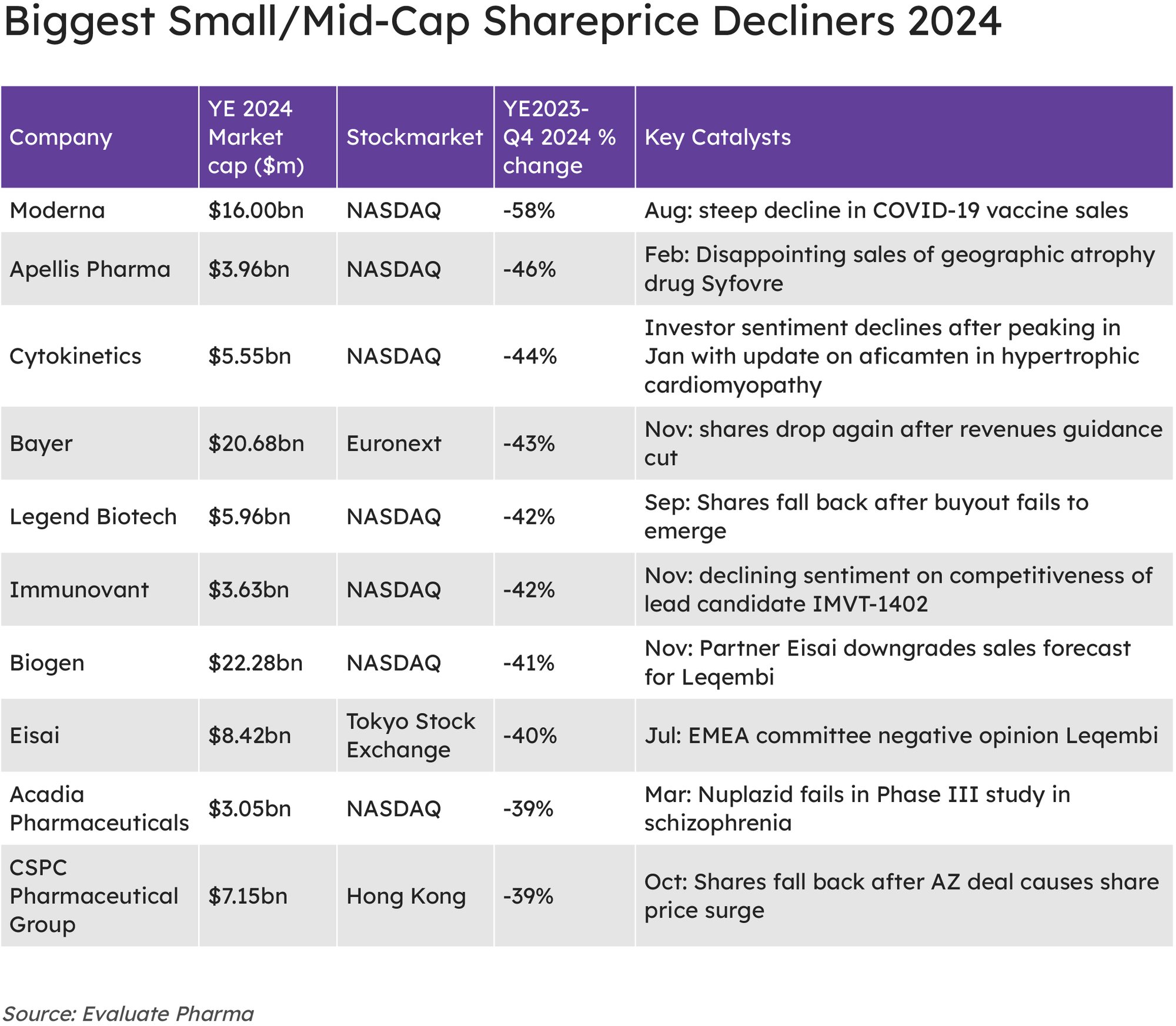
Nevertheless, there were a few star performers– and not just on US exchanges. Evaluate Pharma has compiled a top 10 of the best-performing stocks across mid-cap companies, as well as the ten firms that saw their stock sink the most over the 12-month period.
Last year was far from vintage for the biotech sector in terms of stock performance.
Claiming the prize of biggest share price increase was Summit Therapeutics, which saw its market cap grow sixfold. Its stock went through the roof in September when its partner Akeso unveiled data from the HARMONi-2 trial of its dual PD-1/VEGF inhibitor, ivonescimab, in first-line non-small-cell lung cancer (NSCLC). Ivonescimab became the first drug to achieve clear progression-free survival superiority to Merck & Co’s anti-PD1, Keytruda (pembrolizumab), in this setting.
Claiming the prize of biggest share price increase was Summit Therapeutics.
Summit must now replicate the success of this China-based Phase III study with a global/US one, and investors are convinced that its management team – which previously worked together at via Pharmacyclics to bring BTK inhibitor ibrutinib to market with J&J and a $21bn buyout by AbbVie – can achieve success again.
It is notable that Akeso, listed on the Hong Kong exchange and holding the China rights, did not enjoy the same magnitude of uplift, its shares rising by only around 50% over the year, underlining the importance of the US market and US investors in fueling biotech stocks.
In second place is Janux, which saw its shares take off with highly promising data from its in prostate cancer treatment, JANX007.
While there are many companies looking to develop T-cell engager antibody drugs, Janux’s drug could be best-in-class for safety and efficacy.
While there are many companies looking to develop T-cell engager antibody drugs, Janux’s drug could be best-in-class for safety and efficacy, based on its “masking” technology which blocks activity against healthy tissue.
The company is now moving JANX007 into Phase Ib expansion trials, with updates expected in 2025.
Once a formidable big pharma player, Bayer has been dragged down by strategic missteps and evaporating investor confidence. Efforts by CEO Bill Anderson to hack away at dead wood at the company have not yet inspired renewed confidence in the firm, and its shares declined by a whopping 25% in November after the company warned about future earnings.
Management will hope that the expected US approval of elinzanetant for vasomotor symptoms (hot flashes) associated with menopause and market expansion for its prostate cancer drug, Nubeqa (darolutamide), will begin to turn things around in 2025.
The outlook is perhaps even gloomier for Moderna, which won the unenviable prize of the being the company with the steepest share price decline last year. Unfortunately, that trend has only continued in 2025, with its share losing a further 20% so far, after analysts at Morgan Stanley said the firm’s COVID-19 vaccines revenues would shrink again this year.
Being on either the fastest-growing or fastest declining stock lists makes a company a potential target for a buyout.
Other companies on the list were less victims of fundamental problems with the pipeline, and more the excitable nature of investors when a buyout could be in the making.
Legend Biotech saw its share price rise steeply in the summer when rumors of a potential acquisition by its partner J&J emerged. However, when no offer materialized, the excitement turned to disappointment, and Legend ended up 42% down at the end of 2024.
Being on either the fastest-growing or fastest declining stock lists makes a company a potential target for a buyout – though on contrasting valuations – and analysts expect big pharma to be more active in this field this year than last.